Blog
Business Strategies
3 Rules for Building Better Product Bundles in 2026
Struggling to make product bundles actually convert? Simple Bundles' Tina Donati shares three rules for building bundles that drive revenue — without relying on steep discounts.

Lucky Orange
Bundling is one of the most powerful levers in e-commerce — but most brands are using it wrong. They slap a discount on a few products, call it a bundle, and wonder why it underperforms.
Tina Donati, founder of ContentCurve and head of marketing at Simple Bundles, joined the Lucky Orange Show to share a smarter framework. Simple Bundles powers bundling for over 20,000 Shopify brands, and Tina has seen what separates the strategies that drive real revenue from those that quietly erode margin.
She walked us through three rules that can change how you think about bundling — whether you're just getting started or trying to untangle a messy backend that's slowly breaking under the weight of your catalog.
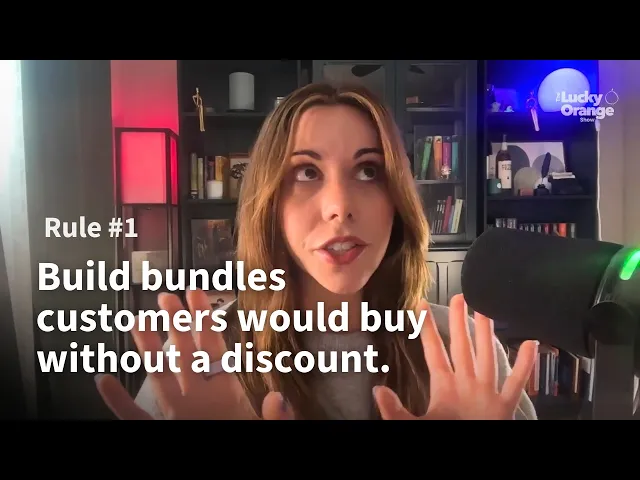
Rule #1: Build Bundles Customers Would Buy Without a Discount
The most common mistake brands make is treating discounts as the reason to bundle. The discount isn't the offer — the bundle is. If the pairing doesn't make sense on its own, a 20% reduction isn't going to rescue it.
"The best offers I've seen don't have a super steep discount at all. It's about creating logical pairings that help someone solve a specific problem."
Tina pointed to Silk and Snow, a Canadian home goods brand, as a standout example. During a recent Black Friday campaign, they offered a deal where purchasing a mattress unlocked discounts on bed frames and bedding. The discount was there — but it wasn't the point. The point was completing the bedroom. If someone is ready to buy a mattress, they're probably ready to redo the whole room. The bundle just made that decision easy.
That's the mindset shift: a good bundle feels smart, not desperate. When the products belong together — a skincare routine for oily skin, a gift box for Valentine's Day, a complete bedroom set — customers don't need to be convinced by price alone. The combination sells itself.
So how do you figure out what to bundle? Tina outlined three practical approaches:
Logical pairings: Products that complete a use case — a full skincare routine, a gift for a specific occasion, a home setup from scratch.
Seasonality and life events: Valentine's Day, back-to-school, the holidays. Tina cited data from the D2C Index showing that the five to seven days before February 14th drive the highest order volume of the season — because procrastinators are stressed, short on time, and willing to spend more for convenience. Bundles are a perfect fit.
Purchase history: If 5–10% of customers are already buying two products together, or coming back within 30 to 60 days to buy the second item, that's a signal. Simple Bundles recently launched a feature called Bundle Magic that automates this analysis — surfacing bundle suggestions based on real purchase behavior, generating product titles, images, descriptions, and pricing to get you started.
Rule #2: More Choice Can Actually Be Good (When the UI Earns It)
Conventional CRO wisdom says to reduce choices and minimize friction. Tina respectfully disagrees — or at least, says it depends.
"If you have the right user interface, more choice doesn't mean more friction. It makes the bundle feel like it's tailored to that specific shopper."
The key is matching the bundle type to the product category. A fixed bundle — where the products are predetermined — works best when the curation is the value. A nighttime skincare routine, for example, has a specific cleanser, toner, and moisturizer. Giving customers the ability to swap one cleanser for another just introduces confusion. The brand is saying: we know what works together. Trust us.
But apparel is different. Tina recalled pitching a large apparel brand that was selling t-shirt three-packs as fixed sets — each pack had a pre-assigned combination of colors, with no ability to customize. The problem: a customer who liked two of the three colors but hated the third was stuck. They'd either buy the bundle and feel like they got a bad deal, or skip it entirely and buy the individual pieces. A mix-and-match bundle would have solved this entirely.
Beauty brands are a good example of running multiple bundle types simultaneously. A fixed kit makes sense for skincare (where the routine is the product). Mix-and-match makes sense for cosmetics (where shade preference is intensely personal). And a BOGO or free-gift-with-purchase offer makes sense during major promotional moments. None of these conflict — they're just different tools for different jobs.
The throughline: the question isn't "should I give customers choice?" It's "does this bundle type match what customers actually need from this product category?"
Rule #3: Keep Your Bundles Clean on the Backend
This is the rule brands don't think about until something breaks.
Bundling looks simple on the storefront. Behind the scenes, it can quietly create operational chaos — and for a lot of brands, that chaos doesn't surface until they're already in the middle of a high-volume season.
"You don't necessarily realize how messy it gets on the back end until something breaks. And then it's like, oh — this is a problem."
The most common failure points Tina sees across Simple Bundles' customer base:
Inventory drift: Bundle components share SKUs with individual products. If those SKUs aren't syncing properly, you can end up overselling a bundle even when a component is out of stock.
Fulfillment confusion: If order line items aren't being sent to your 3PL correctly, warehouse teams don't know what to pick and pack for bundle orders. Customers get the wrong products — or nothing at all.
Discount conflicts and theme issues: Bundles can interact unexpectedly with discount logic and Shopify theme configurations in ways that break the storefront or the offer.
Reporting gaps: If bundle data isn't syncing properly to Shopify, you can't measure bundle performance — which means you can't optimize it.
The fix is about building a clean mapping between what's being sold on your storefront and what's being managed in your warehouse and ERP. Shopify isn't a warehouse system. Your 3PL doesn't natively understand Shopify's digital product configuration. Something has to sit in between and translate between them.
When that translation is working correctly, you get accurate pick-and-pack workflows, correct shipping rates based on true bundle dimensions and weight, the ability for customers to return individual bundle items, and reliable inventory tracking across every system in your stack.
Tina's advice for brands in either position — those who want to start bundling and those who've already made a mess of it — is largely the same: get the operational infrastructure right before you scale. The cost of cleaning it up mid-season is far higher than the cost of building it properly from the start.
The Bottom Line
Bundling isn't a sale tactic. It's a strategy — and like any strategy, it only works when every layer is aligned: the offer logic, the customer experience, and the operational infrastructure.
Build bundles that earn their price. Match the bundle type to what customers actually need. And make sure the backend can support what you're selling on the front end.
Lucky Orange